 |
| EIFFEL TOWER |
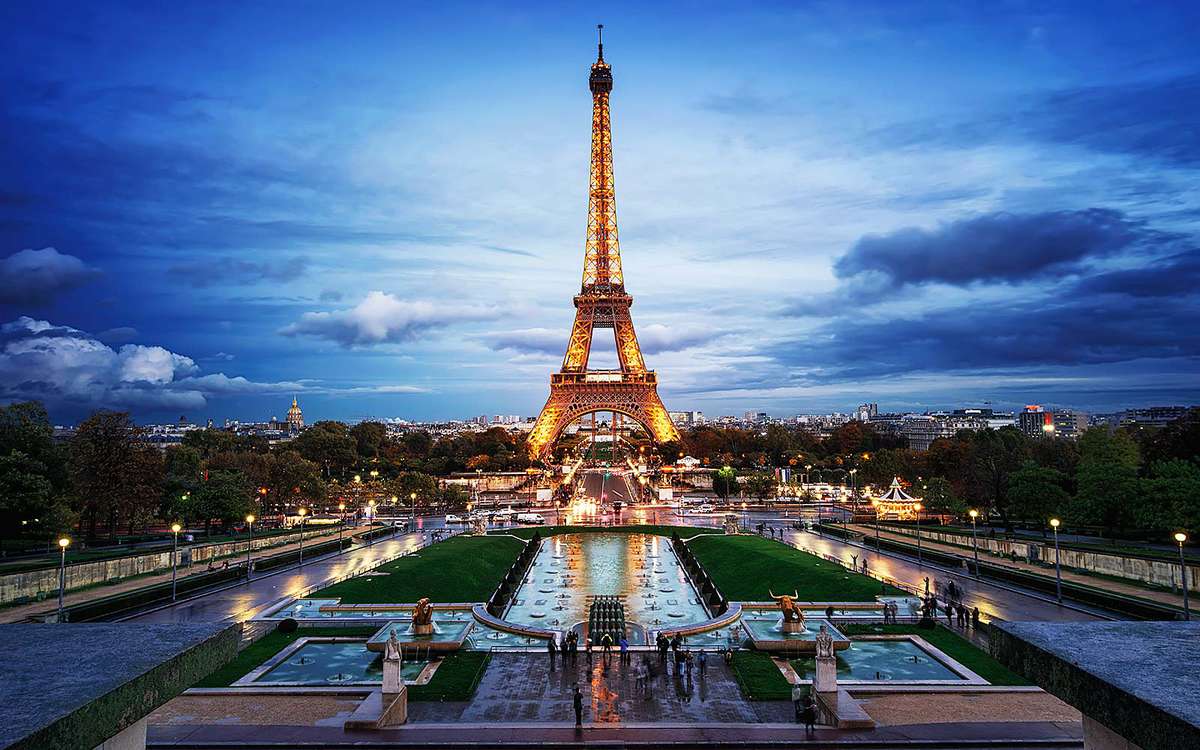
Eiffel Tower, French Tour Eiffel, Parisian milestone that is likewise an innovative magnum opus in building-development history. At the point when the French government was coordinating the International Exposition of 1889 to praise the century of the French Revolution, a contest was held for plans for a reasonable landmark. In excess of 100 plans were submitted, and the Centennial Committee acknowledged that of the prominent scaffold engineer Gustave Eiffel. Eiffel's idea of a 300-meter (984-foot) tower assembled as a rule of open-cross section created iron excited awe, doubt, and no little resistance on stylish grounds. At the point when finished, the pinnacle filled in as the passageway door to the composition.
Nothing distantly like the Eiffel Tower had at any point been fabricated; it was twice just about as high as the arch of St. Peter's in Rome or the Great Pyramid of Giza. As opposed to such more established landmarks, the pinnacle was raised in around two years (1887–89), with a little workforce, at slight expense. Utilizing his high level information on the conduct of metal curve and metal support structures under stacking, Eiffel planned a light, breezy, yet solid construction that augured an unrest in structural designing and engineering plan. Also, after it opened to the general population on May 15, 1889, it eventually justified itself stylishly.
The Eiffel Tower remains on four cross section support docks that tighten internal and join to shape a solitary enormous vertical pinnacle. As they bend internal, the wharfs are associated with one another by organizations of supports at two levels that manage the cost of review stages for travelers. On the other hand, the four crescent curves at the pinnacle's base are simply stylish components that serve no underlying capacity. In light of their remarkable shape, which was directed halfway by designing contemplations yet in addition somewhat by Eiffel's imaginative sense, the docks expected lifts to rise on a bend; the glass-confine machines planned by the Otis Elevator Company of the United States became one of the chief provisions of the structure, building up it as one of the world's head vacation spots.
The actual pinnacle is 300 meters (984 feet) high. It lays on a base that is 5 meters (17 feet) high, and a TV radio wire on the pinnacle provides it with an absolute height of 324 meters (1,063 feet). The Eiffel Tower was the tallest construction on the planet until the garnish off of the Chrysler Building in New York City in 1929.
This article was most as of late overhauled and refreshed by Adam Augustyn, Managing Editor, Reference Content.
Paris, France
Paris: Around the Eiffel Tower
Back inside as far as possible, south of Place Charles de Gaulle, is the Chaillot Palace (Palais de Chaillot). Remaining on an ascent on the Right Bank of the Seine, where the waterway starts its southwestward bend, the royal residence is a great spot from…
Kedleston Hall
Western engineering: Construction in iron and glass
The Eiffel Tower (1887–89), the main seal of the Paris presentation of 1889, was planned by Gustave Eiffel, an architect who had accomplished remarkable work in the Paris Exposition of 1878 and in steel constructions, for example, the supported explanatory curves in the viaduct at…
… Paris Exposition of 1889: the Eiffel Tower and the Gallery of Machines. Gustave Eiffel's pinnacle was 300 meters (1,000 feet) high, and its natural allegorical bended structure has turned into an image of Paris itself; its tallness was not surpassed until the garnish off of the 318.8-meter-(1,046-foot-) tall Chrysler Building…


No comments:
Post a Comment