The sun, clarified
Get familiar with the nurturing star at the focal point of our nearby planet group.
 |
| SUN |
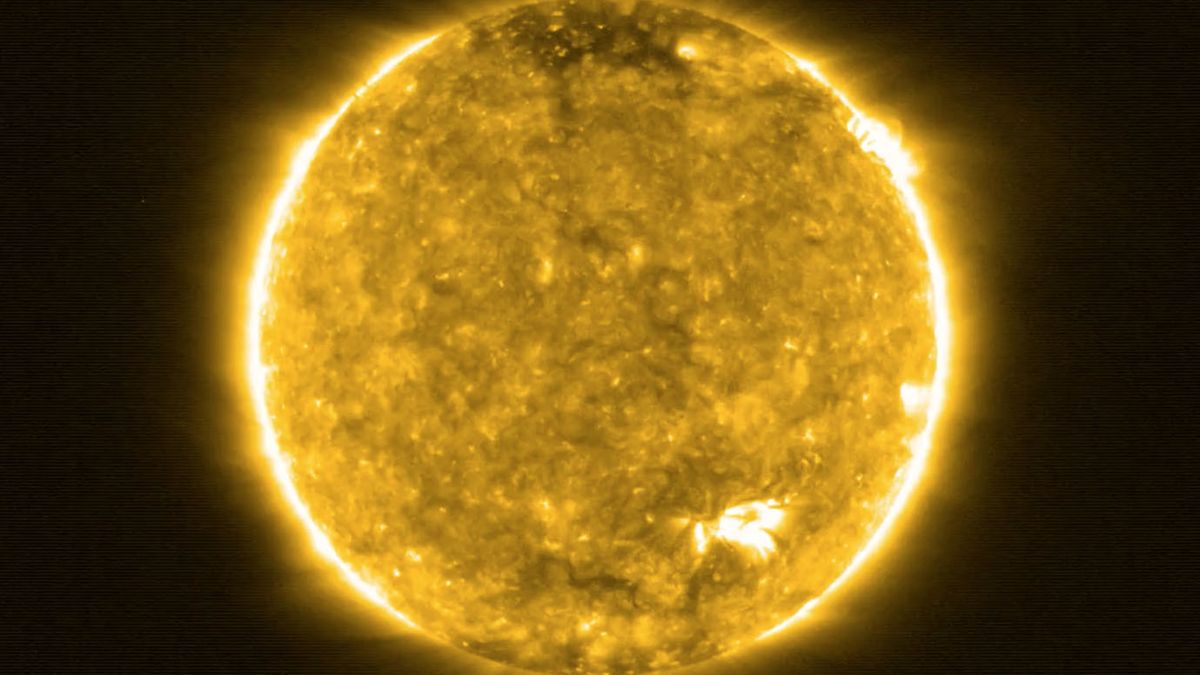
Contrasted and the billions of different stars in the universe, the sun is unexceptional. In any case, for Earth and different planets that spin around it, the sun is an amazing main focus. It holds the nearby planet group together; gives nurturing light, hotness, and energy to Earth; and produces space climate.
Qualities of the sun
The sun lives nearly 26,000 light-years from the Milky Way's middle, in a ring of our home world known as the Orion Arm. Each 230 million years, the sun—and the planetary group it conveys with it—makes one circle around the Milky Way's middle. However we can't feel it, the sun follows its circle at a normal speed of 450,000 miles 60 minutes.
The sun shaped more than 4.5 billion years prior, when a dust storm and gas called a cloud fell under its own gravity. As it did, the cloud turned and straightened into a circle, with our sun framing at its middle. The plate's edges later accumulated into our planetary group, including Earth and different planets. Researchers have even figured out how to see these planet-birthing plates around our sun's far off youthful cousins.
Our home star is a yellow smaller person, a medium-size assortment that is genuinely normal in our system. The mark "yellow" is deceiving, however, since our sun consumes a radiant white. On Earth, the sun can take on hotter tints, particularly at the crack of dawn or nightfall, on the grounds that our planet's environment dissipates blue and green light the most.
According to our point of view, "overshadow" probably won't be the best word for our sun, all things considered. At around 864,000 miles (1.4 million kilometers) wide, the sun is multiple times more extensive than Earth, and it represents more than 99.8 percent of the planetary group's complete mass. In case it was an empty ball, beyond what 1,000,000 Earths could fit inside it. Yet, the sun isn't empty: It's loaded up with burning gases and soups of electrically charged particles called plasma. (Deeply.
Somewhere down in the sun's center, atomic combination changes hydrogen over to helium, which produces energy. Particles of light called photons bring this energy through a circular shell called the radiative zone to the top layer of the sun powered inside, the convection zone. There, sweltering plasmas rise and fall like the seepage in an astro light, which moves energy to the sun's surface, called the photosphere.
It can require 170,000 years for a photon to finish its excursion out of the sun, yet when it exits, it speeds through space at in excess of 186,000 miles every second. Sun oriented photons arrive at Earth around eight minutes after they're liberated from the sun's inside, crossing a normal of 93 million miles to arrive—a distance characterized as one cosmic unit (AU).
Out past the sun's photosphere lies the environment, which comprises of the chromosphere and the sunlight based crown. The chromosphere seems as though a ruddy sparkle bordering the sun, while the crown's immense white rings broaden a huge number of miles long. The chromosphere and crown additionally emanate apparent light, yet on Earth's surface, they can be seen distinctly during a complete sun based shroud, when the moon passes among Earth and the sun.
The crown runs far more blazing than the photosphere, hitting temperatures of in excess of 1,000,000 degrees Fahrenheit. How the crown gets so hot remaining parts a logical secret, which is incompletely why NASA dispatched its Parker Solar Probe, the quickest shuttle at any point assembled, and the initial at any point sent into the crown. (Peruse more with regards to the rocket that will "contact the sun.")
Sun oriented breeze and flares
Notwithstanding light, the sun transmits heat and a constant flow of charged particles known as the sun powered breeze. The breeze blows around 280 miles (450 kilometers) a second all through the planetary group, expanding the sun's attractive field out in excess of 10 billion miles. Past that distance, the sunlight based breeze gives way to the colder, thick material that floats in the middle of stars, framing a limit called the heliopause. Up until now, only two rocket—Voyager 1 and Voyager 2—have passed this inestimable boundary, which characterizes the beginning of interstellar space.
Sometimes, a fix of particles will erupt from the sun in a sun based flare, which can disturb satellite correspondences and take out power on Earth. Flares normally come from the movement of sunspots, cool areas of the photosphere that frame and disperse as the sun's inward attractive field shifts. Sunlight based flares and sunspots comply with a customary cycle, rising and falling in number like clockwork as the shafts of the sun's attractive field flip to and fro.
Some of the time, the sun will likewise dispatch tremendous air pockets of polarized particles from its crown, in occasions called coronal mass discharges (CMEs). Some CMEs can develop as extensive as the actual sun and throw as much as a billion tons of material in a provided guidance. As they surge from the sun, CMEs can send colossal shockwaves through the sun based breeze. In the event that a CME crashed into Earth, its particles could pack sufficient ability to broil hardware in circle and on Earth's surface.
In the same way as other energy sources, the sun will not keep going forever. It has as of now spent almost 50% of the hydrogen in its center. The sun will keep on consuming the hydrogen for another five billion years or somewhere in the vicinity, and afterward helium will turn into its essential fuel. By then, the sun will grow to multiple times its present size, gulping Mercury and Venus—and possibly Earth. It will consume as a red goliath star for an additional billion years and afterward breakdown into a white small star.


No comments:
Post a Comment